The implementation of Goods and Services Tax (GST) has transformed India’s indirect taxation system. For businesses, GST registration and compliance are not just statutory requirements — they are essential for smooth operations, tax efficiency, and long-term credibility.
Whether you are a startup, SME, or established enterprise, understanding the GST registration process and compliance framework is critical to avoid penalties and disruptions.
In this comprehensive guide, B S D & Co., Chartered Accountants, explains:
- Who needs GST registration
- Step-by-step registration process
- Documents required
- GST return filing requirements
- Common compliance mistakes
- Benefits of professional GST support
What is GST?
Goods and Services Tax (GST) is a unified indirect tax levied on the supply of goods and services across India. It replaced multiple indirect taxes such as VAT, Service Tax, and Excise Duty.
GST is categorized into:
- CGST (Central GST)
- SGST (State GST)
- IGST (Integrated GST for interstate transactions)
Every registered business is assigned a unique GSTIN (Goods and Services Tax Identification Number).
Who Needs GST Registration?
GST registration is mandatory for:
- Businesses with turnover exceeding the prescribed threshold limit
- Interstate suppliers of goods/services
- E-commerce sellers
- Casual taxable persons
- Input Service Distributors
- Businesses liable under reverse charge mechanism
Even if not mandatory, voluntary registration can help businesses:
- Claim Input Tax Credit (ITC)
- Improve credibility with clients
- Expand across states
- Work with larger corporates
Turnover Threshold for GST Registration
As per current provisions (subject to government updates):
- ₹40 lakhs for goods suppliers (in most states)
- ₹20 lakhs for service providers
- ₹10 lakhs for special category states
Businesses exceeding these limits must apply for GST registration within the prescribed timeline.
Step-by-Step GST Registration Process
Here’s how GST registration in India works:
Step 1: Visit GST Portal
Access the official GST portal and initiate new registration.
Step 2: Fill Part A
Enter:
- PAN
- Mobile number
- Email ID
- State
You will receive OTP verification.
Step 3: Fill Part B
Provide detailed information including:
- Business name and address
- Nature of business activity
- Bank account details
- Authorized signatory details
Step 4: Upload Required Documents
Step 5: ARN Generation
After submission, an Application Reference Number (ARN) is generated.
Step 6: Verification & Approval
If documents are proper, GSTIN is issued within a few working days.
Incorrect documentation may result in rejection or clarification notices.
Documents Required for GST Registration
The required documents include:
- PAN card of business/entity
- Aadhaar of promoters/partners/directors
- Address proof of business place
- Bank account proof (cancelled cheque or statement)
- Certificate of incorporation (for companies)
- Partnership deed (if applicable)
- Digital Signature Certificate (for companies/LLPs)
Proper documentation ensures faster approval.
Types of GST Registration
Depending on business structure, registration types include:
- Regular Taxpayer
- Composition Scheme
- Casual Taxable Person
- Non-Resident Taxable Person
- Input Service Distributor
Choosing the correct category is crucial for tax optimization and compliance.
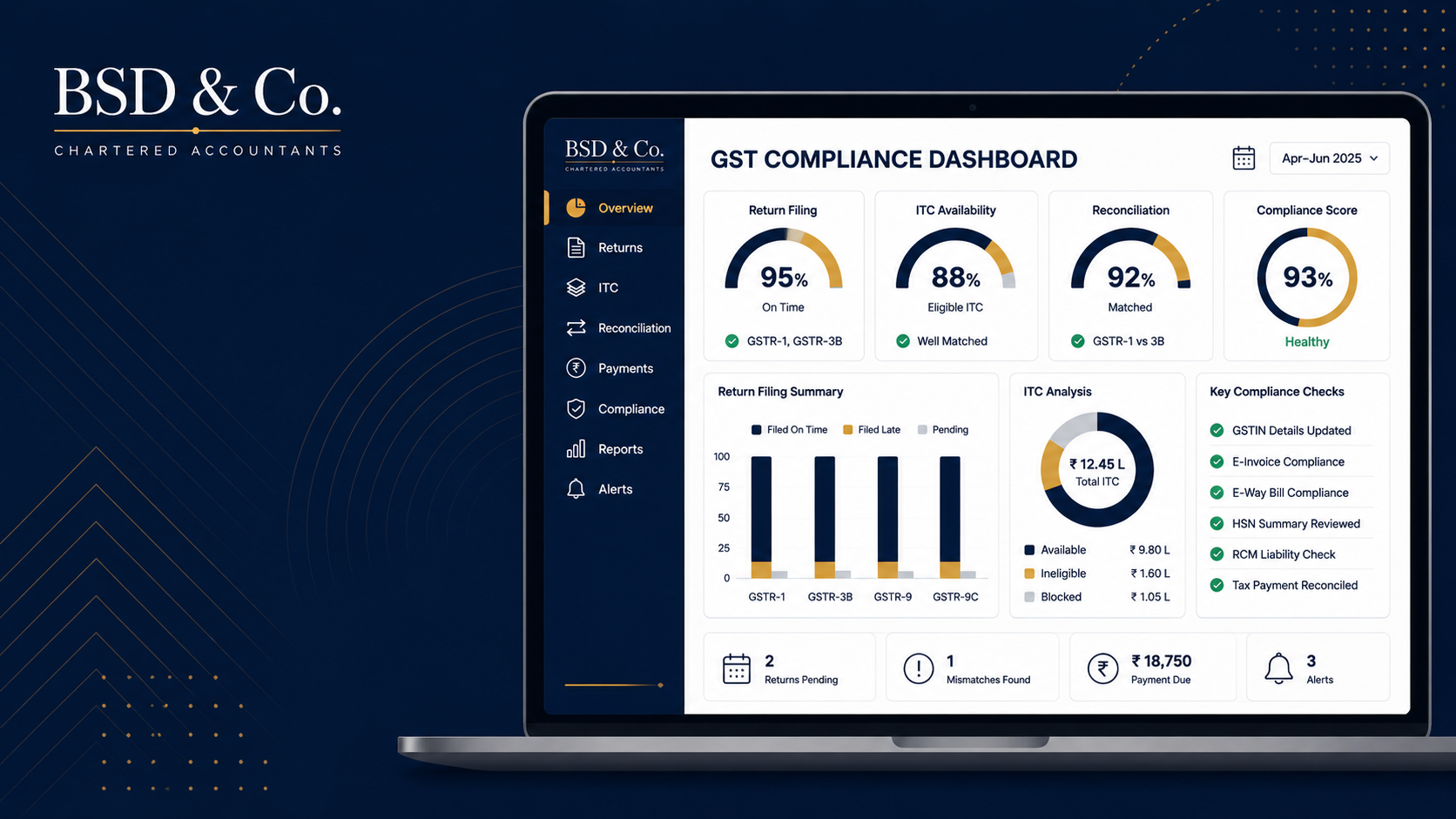
GST Return Filing Requirements
After registration, compliance begins.
Common GST returns include:
GSTR-1
Details of outward supplies (monthly/quarterly)
GSTR-3B
Monthly summary return with tax payment
GSTR-9
Annual return
GSTR-9C
Reconciliation statement (for applicable taxpayers)
Timely filing avoids:
- Late fees
- Interest penalties
- GST notices
- Suspension of GSTIN
Importance of Input Tax Credit (ITC)
One of the biggest advantages of GST is Input Tax Credit (ITC).
Businesses can claim credit for GST paid on purchases, reducing overall tax liability.
However, ITC can only be claimed if:
- Supplier has filed returns
- Invoice details match in GSTR-2A/2B
- Goods/services are used for business purposes
Improper ITC claims often trigger GST scrutiny.
Common GST Compliance Mistakes
Many businesses face notices due to:
- Mismatch between GSTR-1 and GSTR-3B
- Incorrect HSN/SAC codes
- Delay in return filing
- Wrong tax rate application
- Not reconciling books with GST returns
- Claiming ineligible ITC
Regular reconciliation and expert supervision minimize such risks.
GST for Startups and Growing Businesses
For startups, GST compliance plays a crucial role in:
- Building vendor trust
- Participating in tenders
- Working with corporate clients
- Expanding interstate operations
Early compliance builds long-term financial discipline.
Penalties for Non-Compliance
Failure to comply with GST provisions may result in:
- Late filing fees (per day penalty)
- Interest on unpaid tax
- Suspension or cancellation of GST registration
- Legal proceedings
Consistent compliance prevents business disruptions.
Benefits of Professional GST Advisory
While GST registration can be done online, expert guidance ensures:
- Correct classification of goods/services
- Proper tax rate application
- Accurate return filing
- ITC optimization
- Timely compliance
- Representation before GST authorities
At B S D & Co., we provide structured GST registration and compliance services tailored to startups, SMEs, and corporates.
Why Choose B S D & Co. for GST Services?
With decades of professional experience, we offer:
- End-to-end GST registration
- Monthly & quarterly return filing
- GST audit and reconciliation
- ITC advisory
- Notice handling & representation
- Compliance monitoring
Our proactive approach ensures businesses remain compliant while focusing on growth.
Conclusion
GST registration and compliance are foundational to running a legally compliant and financially disciplined business in India. From registration to return filing and audit readiness, structured GST management protects your business from penalties and enhances credibility.
If you are planning to register under GST or need assistance with compliance, consult B S D & Co., Chartered Accountants for reliable and professional support.