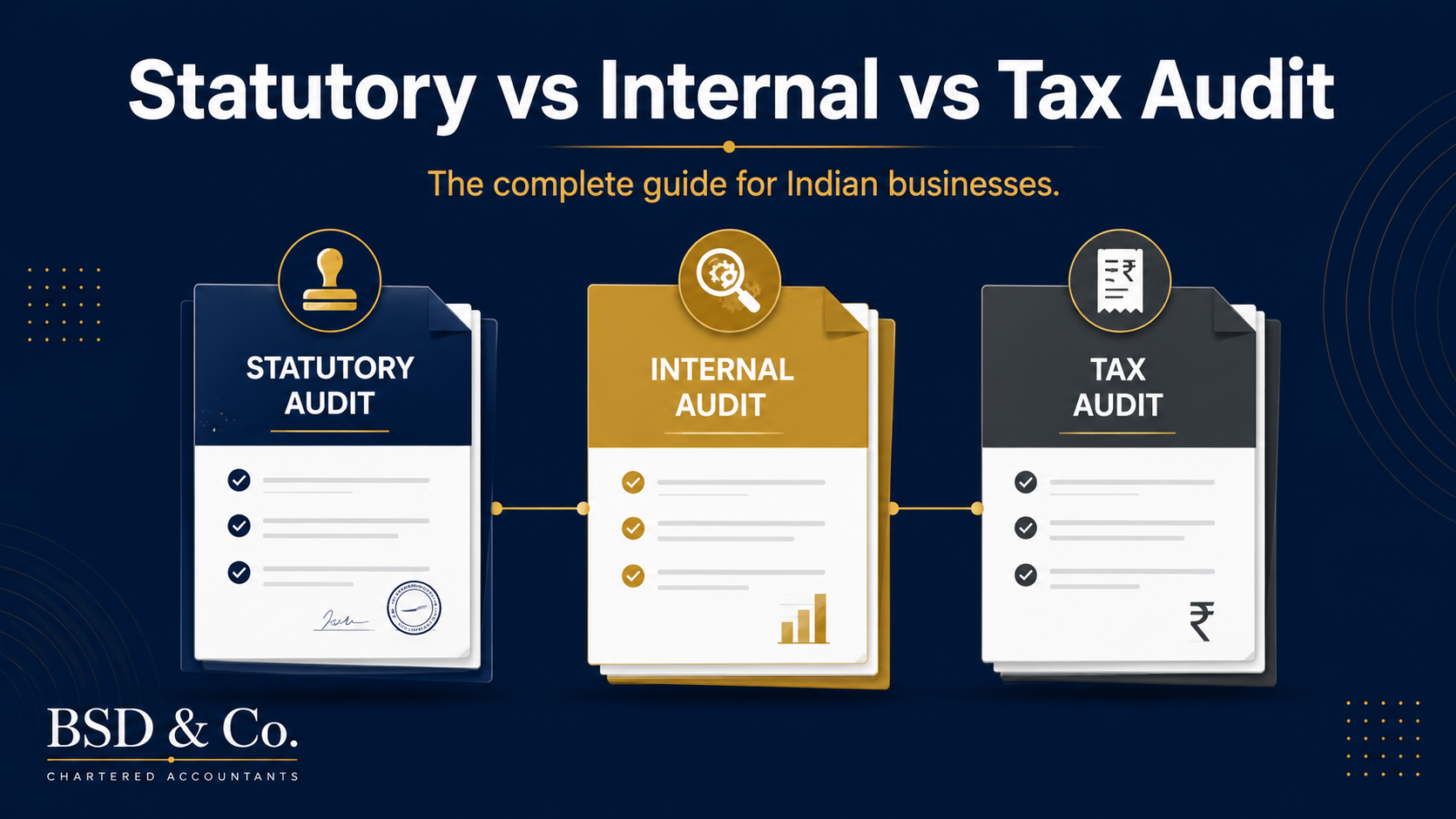
Audits play a critical role in ensuring financial transparency, regulatory compliance, and operational efficiency for businesses. However, many entrepreneurs and business owners often confuse Statutory Audit and Internal Audit, assuming they serve the same purpose.
While both audits evaluate financial and operational aspects of an organization, they differ significantly in scope, objective, legal requirement, and reporting structure.
In this detailed guide, B S D & Co., Chartered Accountants, explains:
- What is a statutory audit?
- What is an internal audit?
- Key differences between statutory and internal audits
- Legal applicability
- Benefits for businesses
- Which audit your business requires
What is a Statutory Audit?
A Statutory Audit is a legally mandated audit conducted to examine the accuracy and fairness of a company’s financial statements. It ensures that financial records comply with applicable laws and accounting standards.
In India, statutory audits are primarily governed under:
- Companies Act, 2013
- Income Tax Act (Tax Audit under Section 44AB)
- Banking Regulation Act
- Other regulatory frameworks
The main objective of a statutory audit is to provide an independent opinion on whether the financial statements present a true and fair view of the company’s financial position.
Key Features of Statutory Audit
- Mandatory for certain entities
- Conducted by an independent Chartered Accountant
- Focused on financial statements
- Report submitted to shareholders/regulators
- Annual requirement
What is an Internal Audit?
An Internal Audit is an independent and objective evaluation of a company’s internal controls, risk management systems, and operational efficiency.
Unlike statutory audit, internal audit is not always mandatory (except for specified classes of companies under the Companies Act).
Internal audit focuses on:
- Risk assessment
- Internal control systems
- Process improvement
- Fraud detection
- Operational efficiency
It acts as a management tool rather than merely a compliance requirement.
Key Features of Internal Audit
- May be mandatory for certain companies
- Focuses on internal processes
- Conducted periodically (quarterly/monthly)
- Reports submitted to management
- Helps improve systems and controls
Statutory Audit vs Internal Audit: Major Differences
Below is a clear comparison to understand both better:
1. Purpose
Statutory Audit:
Ensures compliance with legal and regulatory requirements and validates financial statements.
Internal Audit:
Improves operational efficiency, strengthens internal controls, and manages risks.
2. Legal Requirement
Statutory Audit:
Mandatory for companies and specified entities under law.
Internal Audit:
Mandatory only for certain classes of companies; otherwise optional but recommended.
3. Appointment
Statutory Auditor:
Appointed by shareholders.
Internal Auditor:
Appointed by management or Board of Directors.
4. Reporting Authority
Statutory Audit Report:
Submitted to shareholders and regulatory authorities.
Internal Audit Report:
Submitted to management and audit committee.
5. Scope of Work
Statutory Audit:
Limited to financial statements and statutory compliance.
Internal Audit:
Covers finance, operations, compliance, IT systems, risk management, and internal controls.
6. Frequency
Statutory Audit:
Conducted annually.
Internal Audit:
Conducted periodically throughout the year.
Applicability of Statutory Audit in India
Statutory audit is mandatory for:
- All companies registered under Companies Act
- LLPs (above prescribed limits)
- Banks & financial institutions
- Insurance companies
- Certain NGOs and trusts
Failure to comply can lead to penalties, disqualification of directors, and legal consequences.
Applicability of Internal Audit
As per the Companies Act, internal audit is mandatory for:
- Listed companies
- Unlisted public companies meeting certain thresholds
- Private companies meeting prescribed turnover or borrowing limits
Even if not mandatory, internal audit is highly recommended for growing businesses.
Why Statutory Audit is Important
Statutory audit provides:
- Credibility to financial statements
- Investor confidence
- Regulatory compliance
- Transparency
- Reduced risk of financial misstatements
For companies seeking funding, loans, or investment, audited financial statements are essential.
Why Internal Audit is Important
Internal audit offers:
- Early detection of fraud
- Risk mitigation
- Process optimization
- Better resource utilization
- Improved governance
It acts as a preventive mechanism rather than corrective.
Can a Business Require Both?
Yes.
In fact, many businesses require both statutory and internal audits.
- Statutory audit ensures legal compliance.
- Internal audit ensures operational excellence.
Together, they create a robust governance framework.
Common Misconceptions
“If we have a statutory audit, we don’t need internal audit.”
Not true. Statutory audit does not deeply examine operational processes.
“Internal audit replaces statutory audit.”
Incorrect. Internal audit cannot substitute mandatory statutory compliance.
Which Audit is Right for Your Business?
The requirement depends on:
- Business structure
- Turnover
- Regulatory classification
- Industry type
- Risk exposure
Startups and SMEs may voluntarily adopt internal audit systems to strengthen governance early.
Larger companies usually require both audits.
Benefits of Professional Audit Services
Engaging experienced Chartered Accountants ensures:
- Accurate financial reporting
- Compliance with latest regulations
- Reduced risk of penalties
- Structured internal controls
- Strategic financial insights
At B S D & Co., we provide comprehensive statutory and internal audit services tailored to businesses across industries.
Why Choose B S D & Co. for Audit Services?
With decades of professional expertise, we offer:
- Statutory audits under Companies Act
- Tax audits under Income Tax Act
- Internal audit & risk assessment
- Management audit
- Due diligence audits
- Compliance review
Our approach focuses on transparency, accountability, and value addition — not just compliance.
Conclusion
Understanding the difference between statutory audit and internal audit is essential for every business owner. While statutory audit ensures compliance and financial accuracy, internal audit strengthens operational systems and risk management.
Both play distinct but complementary roles in building a sustainable and compliant business structure.
If you need guidance on audit applicability or professional audit services, consult B S D & Co., Chartered Accountants for expert assistance.