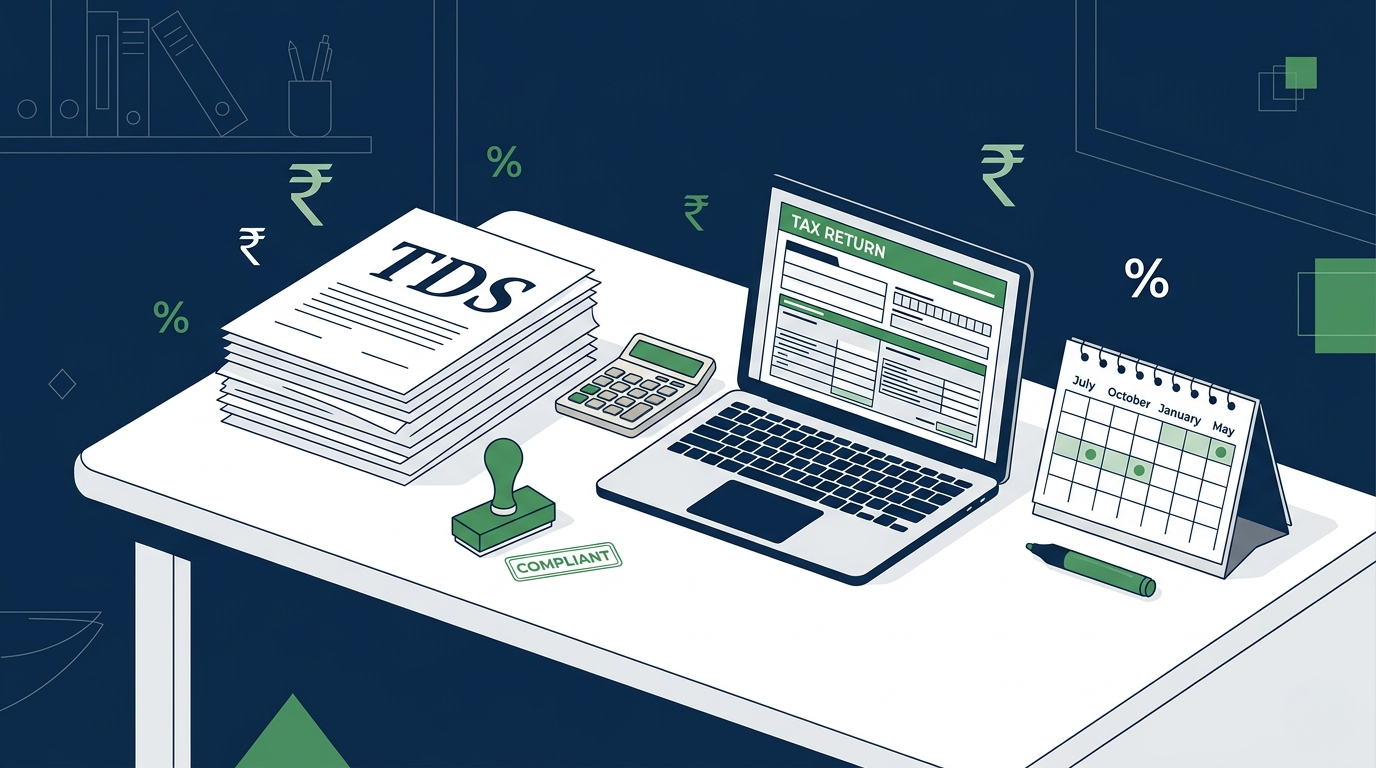
Tax Deducted at Source (TDS) is one of the most frequently invoked provisions of the Income-tax Act, 1961, and also one of the most error-prone areas of business compliance. Whether you are paying salaries, contractor invoices, professional fees, rent, or commissions, the law requires you to deduct tax at the prescribed rate, deposit it with the government, and file periodic returns. Non-compliance attracts interest, penalties, and disallowance of expenses, making TDS a critical area for every business.
This guide walks through the key TDS rates, return forms, due dates, and pitfalls that businesses regularly encounter.
What is TDS and Why It Matters
TDS is a mechanism where the payer (called the deductor) deducts a specified percentage of tax before making certain payments and deposits it directly with the Central Government on behalf of the recipient (the deductee). The recipient can then claim credit for this tax against their final income tax liability.
For businesses, TDS compliance is not optional. Failure to deduct or deposit TDS can result in:
– Interest under Section 201(1A)
– Penalty equal to the TDS amount under Section 271C
– Disallowance of 30 percent of the expense under Section 40(a)(ia)
– Prosecution in serious cases under Section 276B
Key TDS Sections and Rates for FY 2025-26
The most commonly applicable TDS sections include:
Section 192 – Salary: TDS at the average rate based on the employee’s projected annual income and chosen tax regime.
Section 194A – Interest other than securities: 10% on interest above Rs. 40,000 (Rs. 50,000 for senior citizens) from banks, and Rs. 5,000 from others.
Section 194C – Payment to contractors: 1% for individuals/HUF, 2% for others, on payments above Rs. 30,000 per invoice or Rs. 1,00,000 in aggregate per year.
Section 194H – Commission and brokerage: 2% on payments above Rs. 20,000.
Section 194I – Rent: 2% on plant and machinery, 10% on land, building, or furniture, with revised threshold of Rs. 6,00,000 per year (Budget 2025).
Section 194J – Professional or technical services: 10% on professional fees, 2% on technical services, with the threshold raised to Rs. 50,000 per year (Budget 2025).
Section 194Q – Purchase of goods: 0.1% on purchases above Rs. 50 lakh from a single supplier in a year, applicable when the buyer’s turnover exceeds Rs. 10 crore.
Section 195 – Payments to non-residents: Variable rates depending on nature of payment and DTAA provisions.
If the deductee does not provide a valid PAN, TDS is deducted at 20% or the prescribed rate, whichever is higher, under Section 206AA.
TDS Payment Due Dates
TDS deducted during a month must be deposited with the government by the 7th day of the following month, except for March, where the due date extends to 30th April. Government deductors paying through book entry have same-day deposit obligations.
Late payment attracts interest at 1% per month for non-deduction and 1.5% per month for non-payment after deduction.
TDS Return Forms and Filing Due Dates
Quarterly TDS returns must be filed using the appropriate form:
– Form 24Q: TDS on salary
– Form 26Q: TDS on payments other than salary to residents
– Form 27Q: TDS on payments to non-residents
– Form 27EQ: TCS returns
Filing due dates are:
– Q1 (April to June): 31st July
– Q2 (July to September): 31st October
– Q3 (October to December): 31st January
– Q4 (January to March): 31st May
Late filing attracts a fee of Rs. 200 per day under Section 234E (capped at the TDS amount), and a penalty of Rs. 10,000 to Rs. 1,00,000 under Section 271H for incorrect or delayed returns.
Issuing TDS Certificates: Form 16 and Form 16A
Once returns are filed, deductors must issue:
– Form 16 to salaried employees by 15th June following the financial year
– Form 16A to other deductees within 15 days of filing each quarterly return
These certificates allow recipients to verify TDS credit in their Form 26AS and Annual Information Statement (AIS) and claim it while filing their own returns.
Common TDS Mistakes Businesses Make
Wrong section application: Treating a professional fee under Section 194C instead of 194J leads to under-deduction and resulting interest and penalty.
Missing PAN validation: Applying lower rates without verifying PAN authenticity triggers retrospective demand at 20%.
Threshold confusion: Many deductors miss the per-invoice versus aggregate threshold distinction under Section 194C.
Ignoring lower deduction certificates: When deductees produce a valid Section 197 certificate, TDS must be deducted at the certified rate, not the standard rate.
Late deposit: Even one-day delays attract interest at 1.5% for the entire month.
Errors in challan-return mapping: Incorrect challan details or unmatched BSR codes lead to defaults flagged on the TRACES portal.
Not reconciling with 26AS/AIS: Failure to reconcile TDS deducted with credits available leads to disputes and refund issues.
TDS Reconciliation and TRACES
The TRACES portal is the central platform for managing TDS compliance. Every business should regularly:
– Review default summaries
– Download justification reports
– Correct mismatches through online correction statements
– Reconcile TDS deposited with the deductee’s Form 26AS
Penalties and Consequences
Repeated TDS non-compliance can lead to:
– Disallowance of 30% of the expense under Section 40(a)(ia) for resident payments
– 100% disallowance under Section 40(a)(i) for non-resident payments
– Prosecution under Section 276B with imprisonment from 3 months to 7 years for failure to deposit
Final Word
TDS compliance is a recurring, high-frequency obligation that requires both accurate classification and disciplined timelines. Even well-run businesses face notices because of small mapping errors or missed thresholds. Building strong internal controls, including supplier PAN verification, automated section mapping, monthly reconciliation, and timely return filing, is the only sustainable approach.
B S D & Co. provides end-to-end TDS advisory and compliance support, including section determination, return preparation, certificate issuance, default resolution on TRACES, and representation before tax authorities. Our experienced team helps businesses stay fully compliant while avoiding the cascading costs of TDS errors.