Choosing between the old and new tax regimes has become one of the most important decisions for Indian taxpayers. Since the new regime became the default option from FY 2023-24, every salaried employee, professional, and business owner must consciously evaluate which structure works better for their financial situation. With the latest revisions announced in Budget 2025 and applicable for FY 2025-26 (Assessment Year 2026-27), this comparison has never been more relevant.
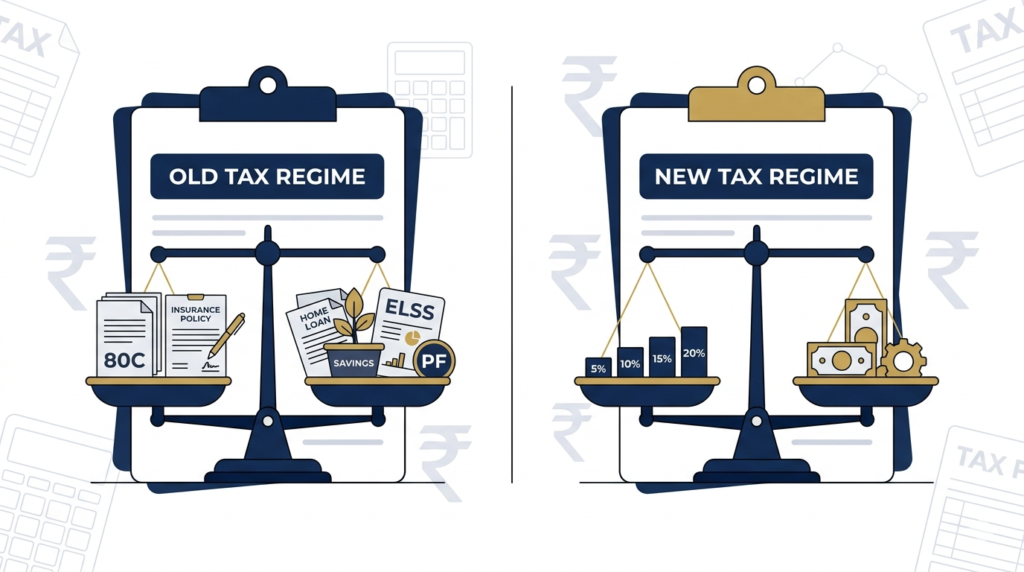
This guide provides a clear, side-by-side breakdown of both regimes to help you make an informed choice.
Understanding the Two Regimes
The old tax regime offers higher slab rates but allows over 70 deductions and exemptions, including HRA, LTA, Section 80C, 80D, Section 24(b) home loan interest, and others. It rewards those who actively invest in tax-saving instruments and incur eligible expenses.
The new tax regime, introduced under Section 115BAC, offers concessional and broader slab rates but largely strips away most deductions and exemptions. It is now the default regime, meaning if you do not opt out, your tax will be computed under it.
Income Tax Slabs for FY 2025-26
New Tax Regime (Default)
– Up to Rs. 4,00,000: Nil
– Rs. 4,00,001 to Rs. 8,00,000: 5%
– Rs. 8,00,001 to Rs. 12,00,000: 10%
– Rs. 12,00,001 to Rs. 16,00,000: 15%
– Rs. 16,00,001 to Rs. 20,00,000: 20%
– Rs. 20,00,001 to Rs. 24,00,000: 25%
– Above Rs. 24,00,000: 30%
A standard deduction of Rs. 75,000 is available for salaried individuals and pensioners. A rebate under Section 87A makes income up to Rs. 12,00,000 effectively tax-free for resident individuals.
Old Tax Regime
– Up to Rs. 2,50,000: Nil
– Rs. 2,50,001 to Rs. 5,00,000: 5%
– Rs. 5,00,001 to Rs. 10,00,000: 20%
– Above Rs. 10,00,000: 30%
A standard deduction of Rs. 50,000 applies for salaried taxpayers, with rebate under Section 87A available for incomes up to Rs. 5,00,000.
What Is Allowed and What Is Not
Old Regime Permits
– Section 80C up to Rs. 1.5 lakh on PF, PPF, ELSS, LIC, and principal repayment
– Section 80D for medical insurance premiums
– HRA exemption under Section 10(13A)
– LTA, food coupons, and other employee benefits
– Section 24(b) home loan interest up to Rs. 2 lakh on self-occupied property
– Sections 80E, 80G, 80TTA, and other eligible deductions
New Regime Permits Only
– Standard deduction of Rs. 75,000
– Employer’s contribution to NPS under Section 80CCD(2), up to 14% of salary
– Family pension deduction
– Interest on let-out property loan
– Agniveer Corpus Fund contributions
Side-by-Side Tax Comparison: Illustrative Examples
Salaried individual earning Rs. 15,00,000 with Rs. 2,00,000 in 80C/80D and Rs. 1,80,000 HRA exemption:
– Old regime tax: approximately Rs. 1,32,600
– New regime tax: approximately Rs. 1,09,200
– The new regime saves nearly Rs. 23,000 in this case.
Salaried individual earning Rs. 20,00,000 with Rs. 4,00,000 in deductions (80C, 80D, home loan interest, HRA):
– Old regime tax: approximately Rs. 2,57,400
– New regime tax: approximately Rs. 2,49,600
– The two regimes are roughly equal; old regime may edge ahead with additional deductions.
Business owner with Rs. 30,00,000 income and minimal investments:
– The new regime is generally more beneficial because deductions are limited and slab rates are lower.
Break-Even Point: When Each Regime Wins
As a rule of thumb, the old regime tends to be advantageous when total deductions exceed approximately 30 percent of gross income for higher salary brackets. For most taxpayers earning between Rs. 7-15 lakhs without significant investments, the new regime is mathematically better. The exact break-even varies based on income level, HRA eligibility, home loan status, and lifestyle expenses.
Who Should Choose Which
The new regime suits:
– Young professionals with limited tax-saving investments
– Taxpayers who do not pay rent or have HRA
– Those without home loans or significant insurance
– Business owners and freelancers seeking simplicity
– Senior citizens with primarily pension income
The old regime suits:
– Salaried employees claiming high HRA in metro cities
– Home loan borrowers with substantial interest payouts
– Individuals with significant 80C, 80D, and NPS investments
– Those with education loans or large donations under 80G
How to Switch Between Regimes
Salaried individuals (without business income) can switch between regimes every financial year while filing their ITR. Taxpayers with business or professional income can switch only once and must use Form 10-IEA to opt out of the new regime.
Common Mistakes to Avoid
Many taxpayers select a regime at the start of the year without recalculating midway when investments or income change. Others forget that the new regime is the default, leading to unintended TDS at higher rates. Always run both calculations using a reliable tax calculator before locking in your choice.
Final Word
There is no universal answer. The right regime depends on your salary structure, deductions, financial goals, and discipline in tax planning. A careful annual comparison can save substantial tax and align your filing with your overall financial strategy.
For personalised tax computation and regime selection, B S D & Co. provides expert advisory tailored to salaried professionals, business owners, and HNIs. Our team helps you evaluate every deduction, apply current slab structures correctly, and choose the regime that maximises your post-tax income while keeping you fully compliant.